The post This Tiny Bright Yellow Frog Is One of the Most Toxic Animals on Earth appeared first on A-Z Animals.
Quick Take
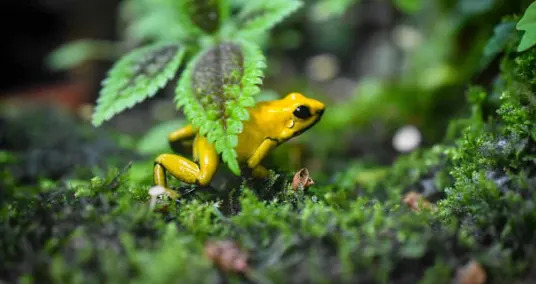
The golden poison dart frog is a brightly colored frog with atoxic skin.
These 2-inch-long frogs live in a very specific part of the rainforest inwestern Colombia.
The poison on their skin is called batrachotoxin, a substance so toxic that one frog can be responsible for multiple deaths.
Researchers continue to study the impressive effects of batrachotoxin on the nervous system.
The golden poison dart frog may be tiny, but it has earned a formidable reputation in the animal kingdom. Native to a small region of rainforest in western Colombia, this brightly colored amphibian is widely regarded as one of the most toxic animals on Earth! Its vivid yellow or orange coloring offers a warning to predators: this little frog is anything but harmless.
What makes the golden poison dart frog so remarkable is not just its extreme toxicity, but that it carries such a powerful natural defense despite its wee size. The poison in its skin is potent enough to make even brief exposure dangerous under the right conditions, and scientists have carefully studied the toxin for what it can reveal about the nervous system. Learn all about the golden poison dart frog, the striking rainforest creature with a deadly chemistry.
Highly Toxic Skin

©Thorsten Spoerlein/Shutterstock.com
First discovered in 1973, the golden poison dart frog is one of the largest species of poison dart frog. Although it is only about 2 inches long, this tiny creature packs a powerful toxic punch. A single frog may carry enough toxin to be lethal to multiple humans under the right exposure conditions (many estimates say as many as 10).
Unlike rattlesnakes and spiders, which deliver toxins through bites, the golden poison dart frog secretes toxin through its skin. This toxin can be dangerous if it enters the body through mucous membranes, damaged skin, or accidental ingestion. Even a very small amount of batrachotoxin can be harmful.
The frog’s skin contains batrachotoxin, a powerful steroidal alkaloid also found in only a few other organisms, including some Pitohui and Ifrita birds of New Guinea. Batrachotoxin is both a cardiotoxin and a neurotoxin, meaning it affects the heart and nervous system.
Specifically, it irreversibly opens sodium channels in nerve cells, disrupting normal nerve and muscle signaling. Batrachotoxin can cause severe neurological and cardiac effects, including paralysis and fatal arrhythmias, and there is no specific antidote.
Identifying Golden Poison Dart Frogs

©reptiles4all/Shutterstock.com
Golden poison dart frogs range in color from bright yellow and orange-yellow to pale greenish, depending on the individual and locality. Juvenile frogs are black with golden stripes running across their backs. As they mature, this multi-colored striped pattern gradually transforms into a more uniform golden hue.
These frogs have long, slender legs and weigh less than an ounce. They are native to a small area of Pacific coastal rainforest in western Colombia, where they live on the ground near rivers and other waterways. Carnivorous by nature, they feed on insects such as flies, beetles, and caterpillars. Like other frogs, they lay eggs, and after hatching, the tadpoles are typically carried on a parent’s back (often the male’s) to a nearby water source.
They may live for several years in the wild and often longer in captivity. Their population is declining primarily because of rainforest destruction caused by logging, mining, and deforestation.
The species is generally listed as Endangered due to its limited range and ongoing habitat loss, though local populations still persist. Some conservation efforts have helped protect these frogs, including places like the Rana Terribilis Amphibian Reserve, where they live in a rainforest environment similar to their native habitat in Colombia.
Poison Arrows

©PLANET EARTH/Shutterstock.com
Indigenous Emberá communities in Colombia have historically used poison from these frogs on blow darts. The toxin was used primarily for hunting and, in some accounts, for defense.
Aware of the danger posed by even a small amount of toxin entering a cut or scratch, people protected their hands with leaves while handling the frogs. With these precautions in place, they would capture the frogs, collect toxin from the skin, and apply it to the tips of darts.
Historical accounts describe several methods of collecting toxin for dart tips. In some cases, a frog was held down with a stick and could provide enough poison for the tips of two to three darts before being released. In other accounts, frogs were impaled on sticks and held over a fire to produce toxin for a larger number of darts. Some sources claim this method yielded enough poison for 20 to 30 darts, though the exact number varies by account. Regardless of the method, the toxin remained potent enough to make the darts highly effective.
Modern Medicine

©mangpor_2004/iStock via Getty Images
Like many natural toxins and poisons, the batrachotoxin found in these frogs has been studied for what it can reveal about nerve and muscle signaling, though it is far too dangerous to be used directly as a medicine. Scientists have also studied and synthesized batrachotoxin-related compounds to better understand how the toxin works.
Researchers are interested in batrachotoxin because it offers important insight into how nerve and muscle cells transmit electrical signals. It affects the nervous system by disrupting the electrical impulses that move through nerves and muscles.
By studying this process, scientists hope to gain a deeper understanding of how electrical signaling influences heart function and pain sensation. While natural toxins can sometimes inspire drug research, batrachotoxin is currently most valuable as a tool for studying ion channels and nerve signaling.
Golden Poison Dart Frogs: A Major Danger?

©lunatic.sadistic/Shutterstock.com
You probably won’t have to worry about encountering these tiny amphibians in your daily life. Although the golden poison frog is extraordinarily toxic, its limited range means it poses little practical threat to most people. As conservation efforts and scientific research continue to expand, it’s worth remembering that there is still much to learn about these remarkable, and highly dangerous, little creatures.
The post This Tiny Bright Yellow Frog Is One of the Most Toxic Animals on Earth appeared first on A-Z Animals.
latest_posts
- 1
 How is 'A Knight of the Seven Kingdoms' connected to 'Game of Thrones'?
 - 2Whale stranded off Germany for days found stuck again
- 3What to know about cheese voluntarily recalled in 20 states
- 4NASA’s Pandora telescope will study stars in detail to learn about the exoplanets orbiting them
- 5'Wow!' The eye surgery marathon that restored sight for some South Africans





- Game theory explains why reasonable parents make vaccine choices that fuel outbreaks
- Why doing good also makes us feel good, during the holidays and beyond
- SF Chinatown's historic Empress of China building being revived into cultural campus
- Find the Wonders of the Silk Street: Following the Antiquated Shipping lanes
- 7 Straightforward Moves toward Move Information from Your Old Cell phone to Your New One: A Thorough Aide
- Was This Driver Simply Having A great time Or Behaving Like An Ass?
- Game theory explains why reasonable parents make vaccine choices that fuel outbreaks
- James Webb Space Telescope discovers a lemon-shaped exoplanet unlike anything seen before: 'What the heck is this?'
- Birds at a college changed beak shapes during the pandemic. It might be a case of rapid evolution