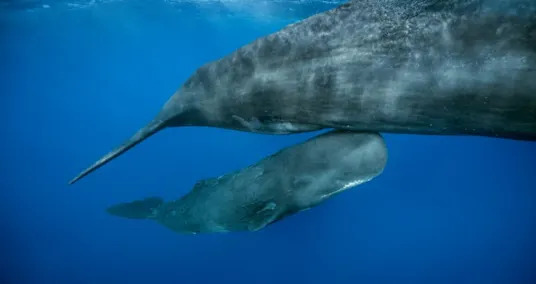
When marine biologist Shane Gero spotted a plume of blood spreading across the water where a group of sperm whales had gathered in the Caribbean, he feared the worst — injury to one of the whales, perhaps from a predator attack. But then he saw something unexpected and extraordinary bob above the waterline: the head of a newborn sperm whale.
A whale’s life wasn’t ending. Rather, a new life was beginning. On July 8, 2023, Gero and the scientific team aboard two boats belonging to Project CETI, or the Cetacean Translation Initiative, a nonprofit for studying whale communication, recorded something that only a handful of people have ever witnessed — the live birth of a whale in the wild.
“I initially thought that something bad was about to happen, until we saw the little head pop out and then the floppy flukes,” said Gero, a CETI field biologist, referring to the whale’s tail. “And then we knew that it was actually a joyous occasion.”
It was also a social occasion, with other whales in the group first surrounding the laboring mother and then lifting the baby out of the water as it took its first breaths. Evidence from this remarkable observation adds nuance to scientific understanding of teamwork among sperm whales. The findings, Gero said, also offer an important lesson for another social species: humans.
“In a cooperative society, if we’re going to succeed, we need to work together, rather than constantly finding reasons to define how we are different,” Gero said. “It’s a pretty great message to take away from an animal that is fundamentally different from us.”
Setting the scene for cetacean birth
On that July day, a CETI team of scientists and technicians — including drone operators, programmers and acoustics experts — were on the open ocean in waters near the Commonwealth of Dominica. The team was expecting a typical day of fieldwork observing a group of mostly female sperm whales that was known to CETI researchers as Group A and had been studied for years. But Gero noticed quickly that something was amiss. The whales were tightly clustered near the surface.
“These families are usually spread across kilometers as they dive and forage,” Gero, a scientist-in-residence at Carleton University in Canada, told CNN. “To have the entire family close together but not really active is kind of unusual.”
One whale that Gero had been observing since she was a calf, known to researchers as “Rounder,” was in labor. Rounder is thought to be at least 19 years old and previously birthed another calf, called “Accra,” in 2017. Scientists tracked the progress of Rounder’s delivery by noting the visibility of the new calf, the behavior of the attending whales, and the appearance and quantities of blood and feces in the water. The team logged the start of birth at 11:12 a.m. local time, and the birth was completed at 11:45 a.m.
“Because of the protocol that we run every day on the water, we had the drones in the air and the recordings running even before we knew it was a birth,” Gero said. Acoustic recordings and images revealed previously unknown behaviors and vocalizations in sperm whale groups post-birth as well, offering unprecedented insights into their interactions.
“Before this observation, our understanding was based on a very small number of fragmentary sightings,” said Giovanni Petri, a network science lead at Project CETI and a professor at Northeastern University’s Network Science Institute in London. “The actual dynamics of birth — who does what, in what order, how the group coordinates, whether non-kin participate — were essentially unknown,” Petri said in an email.
CETI researchers documented the event in two papers, both published March 26. In the journal Science, the study authors described and analyzed the birth using drone footage that they interpreted with machine learning to identify whale identities, positions and interactions. A larger scientific group published a more detailed, minute-by-minute account of the birth and aftermath in the journal Scientific Reports. This is the first study to document an observation of whale birth that combines audio and video from the event with decades of data on social relationships in sperm whales.
“The Project CETI team, which consists of over 50 scientists across eight different disciplines, worked together to publish these studies,” said David Gruber, CETI founder and president and a corresponding author on both papers. Together the whale birth observations and dataset represent “an apex of complexity of sperm whale communication,” he said.
In general, birth observations for wild cetaceans — the group that includes whales, dolphins and porpoises — are exceedingly rare, representing only 10% of species, Gruber noted via email.
“The last scientific record of a sperm whale birth was in 1986, which included only written observations following the birth. Before that there are just a few scattered accounts from whaling vessels,” he said. “What makes this study even more unique is that we have such detailed knowledge of each individual whale and their family relationships.”
‘A group effort’
The group of sperm whales known as Unit A contains 11 individuals: eight adults and three calves. When scientists first saw the newborn, it was still partially inside Rounder, but minutes later it surfaced beside the mother’s head. The other Unit A whales suddenly became a lot more active. They nuzzled and squeezed the newborn, rolling it between their heads and bodies.
The whales then took turns lifting the baby up to the surface, revealing the still-attached umbilical cord. The scientists soon observed that the cord was severed; about three minutes after its first appearance the baby was attempting to swim, though the lifting behavior continued for several hours. Four whales in the group provided most of the attention to the newborn, taking turns with the lifting. One of the most attentive whales, a juvenile named “Ariel,” was not directly related to the mother, showing that even non-kin were active participants in the birth.
The whales also had plenty to say to each other during this time, producing 31,364 clicks over more than four hours. Codas, or groupings of clicks, were longer during the birth and then became shorter after the newborn emerged, the authors wrote in Scientific Reports.
The most common coda type was previously linked to the social identity of whales from this part of the eastern Caribbean. Overlapping codas, which were also recorded that day, are associated with social bonding in sperm whales. Hearing these codas during a highly social event appears to support this interpretation, the authors wrote.

“This is one of the first detailed, quantitative records of a sperm whale birth in the wild — a life stage we almost never get to see in this species,” said Mauricio Cantor, a behavioral ecologist and assistant professor at Oregon State University’s Marine Mammal Institute who was not involved in the sighting.
“What stands out is just how collective the process is. In sperm whales, it’s now very clear that birth isn’t just a mother–calf event — it’s a group effort,” Cantor explained via email. “Multiple females, including non-kin, actively coordinate to support the newborn, keeping it afloat and assisting in its first moments of life.”
A lone young male named “Allan” also lingered nearby. This behavior, too, was unusual, as adolescent males are usually pushed out of the all-female adult groups. Allan was no longer a true member of Unit A. But he kept close during the birth even if he was largely ignored by the others, providing another intriguing detail about the complexity of relationships between sperm whales, said Christine Clarke, a doctoral student studying sperm whales with the Whitehead Lab at Dalhousie University in Halifax, Nova Scotia.
“To my knowledge, Allan is only the second young male to be documented going through the process of leaving his social unit, which all young males eventually do,” Clarke, who was not involved in the research, said in an email. “It felt a bit like watching a soap opera to learn how this family reunion went, with Allan being given the cold shoulder even as he was there participating in the big social event.”
Whale encounters on the open ocean can’t be planned or scheduled, so it’s uncertain when CETI expeditions will see Rounder and her calf again. But each observation adds to a growing body of knowledge about sperm whales’ lives and habits.
“As a team, we were so privileged to observe this moment,” Gruber added. “We hope people also take away the knowledge that this is western science complementing Indigenous knowledge, as people have witnessed and been connected to whales for thousands of years.”
Mindy Weisberger is a science writer and media producer whose work has appeared in Live Science, Scientific American and How It Works magazine. She is the author of “Rise of the Zombie Bugs: The Surprising Science of Parasitic Mind-Control” (Hopkins Press)
Sign up for CNN’s Wonder Theory science newsletter. Explore the universe with news on fascinating discoveries, scientific advancements and more.
For more CNN news and newsletters create an account at CNN.com
latest_posts
- 1
 France bans Muslim gathering citing risk to participants
 - 2They want better health care — so they're turning to crypto startups
- 3Brazilian cardinal orders a popular Catholic priest to go offline following right-wing attacks
- 4Vial marked 'Polonium 210' sparks scare during German Easter egg hunt
- 5Flourishing in a Cutthroat Work Market: Vocation Methodologies





- An Extended time of Self-Reflection: Self-awareness through Journaling
- A definitive Manual for Well known Fragrances
- Best Internet based Course for Learning Another Dialect: Which Stage Do You Like?
- Innospace's rocket crashes in first commercial launch in Brazil; shares tumble
- The Best Internet based Courses for Expertise Improvement
- Instructions to Decide whether a Fender bender Legal counselor is Required for Your Particular Case
- Instructions to Expand Your Advantages from an Open Record Reward
- Tear gas and arrests: Iranian regime continues crackdown on protesters amid economic unrest
- Explainer-What will change with the US reclassification of marijuana?