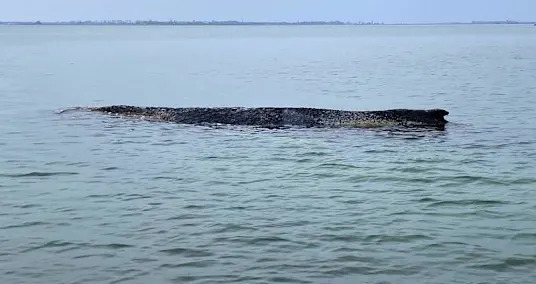
A humpback whale stranded for days off Germany's Baltic coast has gotten stuck on another sandbank, a Greenpeace spokeswoman told dpa on Saturday.
The unlucky animal has garnered massive media attention since it ran aground on a sandbank early on Monday off Germany's Timmendorfer Strand resort, near the city of Lübeck.
Days of efforts to free the 12- to 15-metre whale proved unsuccessful until rescuers dug out a channel in the surrounding sand using a floating excavator on Thursday, allowing the whale to swim free the following night.
However, environmentalists and marine experts had feared that the whale could potentially get stuck again, as it was spotted heading back towards shallower water following its release.
Those fears became reality on Saturday, with the whale spotted stranded on a sandbank in the Bay of Wismar, some 40 kilometres to the east of Timmendorfer Strand, according to Greenpeace.
Incidentally, it was found beached off the unpopulated island of Walfisch, which translates as whale in English.
"After managing to free itself from its [earlier] predicament, the whale was spotted again at midday today in the Bay of Wismar near the island," said a spokesman for the Environment Ministry of the state of Mecklenburg-Vorpommern.
Following initial sightings on Saturday, a plethora of concerned officials, scientists and activists had headed to the Bay of Wismar in case the creature needed assistance again.
Besides Greenpeace activists, water police from the cities of Wismar and Rostock, staff from the German Oceanographic Museum and the Institute for Terrestrial and Aquatic Wildlife Research (ITAW) were on hand both at sea and on land and are assessing the situation, according to the ministry.
Large whales such as humpback whales are not native to the Baltic Sea but occasionally end up there after following schools of fish in search of food, for example.
According to experts, underwater noise could also play a role in this whale's presence in the Baltic Sea.
Biologists had been hoping the whale would make its way back west towards the North Sea, which would have allowed it to reach the open waters of the Atlantic Ocean.
Following its initial release, conservation groups used dinghies to form a kind of blockade to prevent it from entering shallow water again, trying to guide it further into the deeper waters of the Baltic Sea.
However, the whale was soon spotted further east, off the coast of the Mecklenburg district.
According to the ITAW's Stephanie Gross, it was impossible to attach a tracking device to the whale because its skin is too diseased.

latest_posts
- 1
 Flu cases are spiking earlier than usual. What you need to know.
 - 2CMA Awards 2025: Full list of nominations, from Entertainer of the Year to Album of the Year
- 3Artemis II astronauts are more than halfway to the moon as they seek to break Apollo 13's record
- 46 Popular Men's Aromas On the planet
- 5New research reveals urban raccoons across the US show early signs of domestication





- Picking Your Next SUV: 4 Brands Offering Execution, Solace, and Wellbeing
- Little Urban areas to Visit in Western Europe
- A volcanic eruption may have catalyzed the plague's arrival in Europe, study suggests
- A rare whale is having an encouraging season for births. Scientists warn it might still go extinct
- One spent $20 on candy. Another paid $700 for a custom costume. Here's how Halloween costs stacked up this year.
- Kate Middleton and Prince William unveil annual family Christmas card photo with George, Charlotte and Louis
- Instructions to Guarantee Kids Foster Solid Dental Propensities
- Your kid wants it now. What saying yes, no or not yet teaches kids about money and instant gratification.
- 5 VIP Voice Exhibitions in Energized Movies